
A Beginner’s Guide to the Barbell Back Squat
The barbell back squat is one of the best exercises for lower body development. It involves almost every major muscle group below the waist including the quadriceps, glutes, hamstrings and adductors. It also trains the abdominal and erector spinae muscles. Squatting through a full range of motion helps to improve hip, knee, and ankle mobility which is something most adults lose over time. Furthermore, because of the large muscle engagement, squats results in a higher calorie burn and a greater hormonal response compared to other exercises. However, if done incorrectly, it can lead to injury.
In this blog we cover detailed information on how to perform the exercise safely and effectively, including set-up tips and cues.
Before attempting the barbell back squat, you want to ensure that you have adequately progressed through the different squat variations listed below. This will ensure you develop the skill, coordination and lower body strength required for the exercise. It is also recommended to perform various unilateral exercises, such as bodyweight stationary lunges and step-up variations, to build single leg strength and ensure you don’t have any significant muscle imbalances.
The general progression towards a barbell squat would look something like this:
Assisted Body Weight Squat (e.g. TRX Squat)
Bodyweight Box Squat or Chair Squat
Bodyweight Squat (Figure 1)
Dumbbell Squat Variations:
Dumbbell Suitcase Squat (narrow stance)
Dumbbell or Kettlebell Goblet Squat (similar to a front squat)
Dumbbell Sumo Squat (wider stance)
Restricted Range Barbell Back Squat (controlling depth)
Considerations Before Performing the Barbell Back Squat:
Shoes: It is best to wear shoes designed for strength training, or use in the gym. Alternatively, no shoes is a great option. Running shoes tend to be too cushiony which can create a disconnect between your feet and the ground making it harder to feel muscle engagement and foot pressure points.
Bar Choice: If you have tight shoulders use a safety bar rather than a straight bar. Using a straight bar in this situation typically results in the bar sitting too high up on the shoulders, rubbing against C7 of the cervical spine, which can cause irritation. Also choose a bar that is the right weight for your strength level. At the Body Engineers, our safety bar is 65 Ibs, a traditional weight lifting bar is 45 Ibs and we also have a lighter 35 Ibs straight bar.
Safety Pins: If you are training by yourself, or with less supervision, you should use a set-up with safety pins in a squat rack. This provides a safety measure and also gives you a good gauge of how deep you are going for each rep.
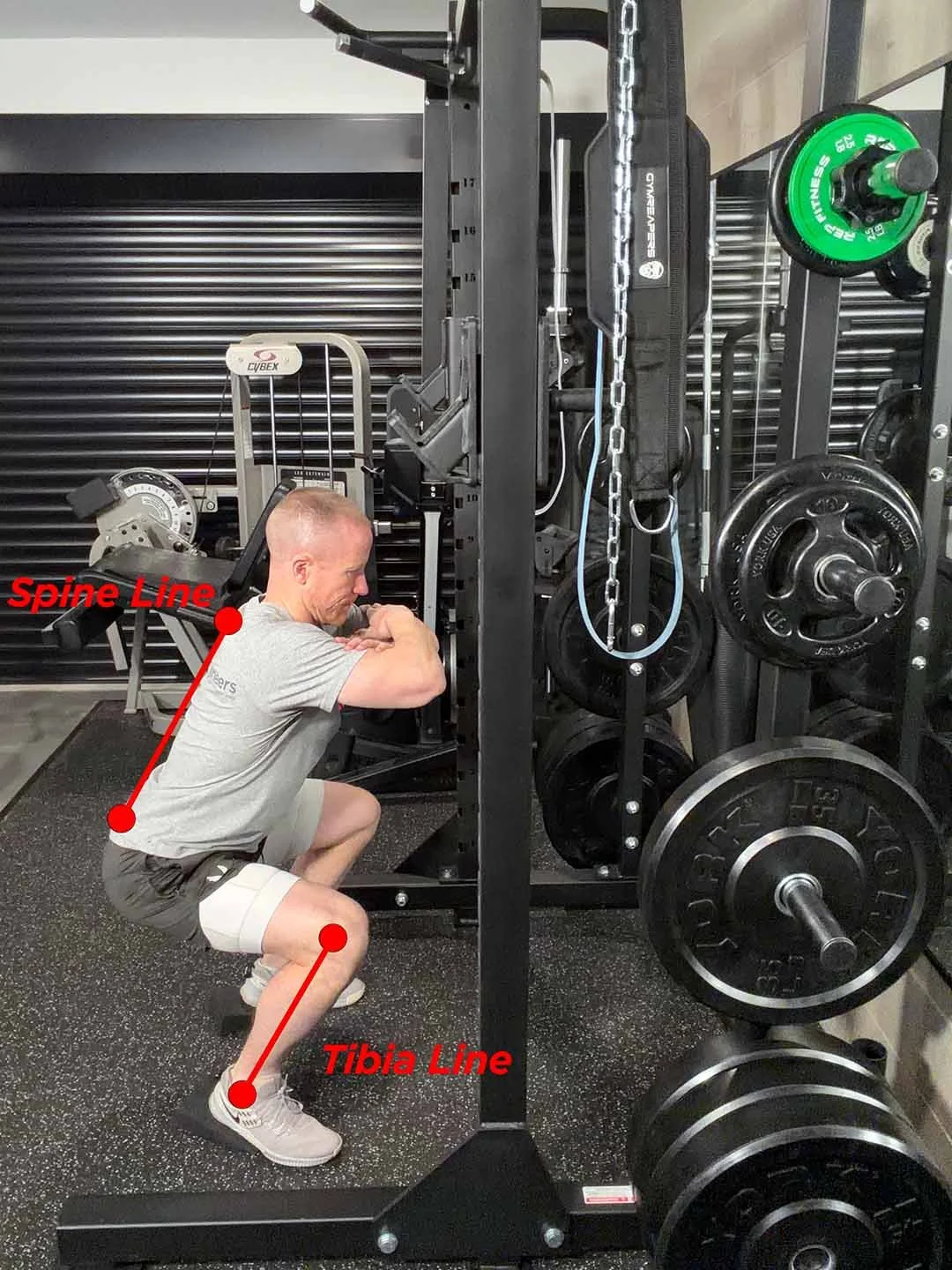
Figure 1: Heels elevated bodyweight squat. Use this to determine safety pin height and foot stance. Note for good form the spine and shin should be parallel.
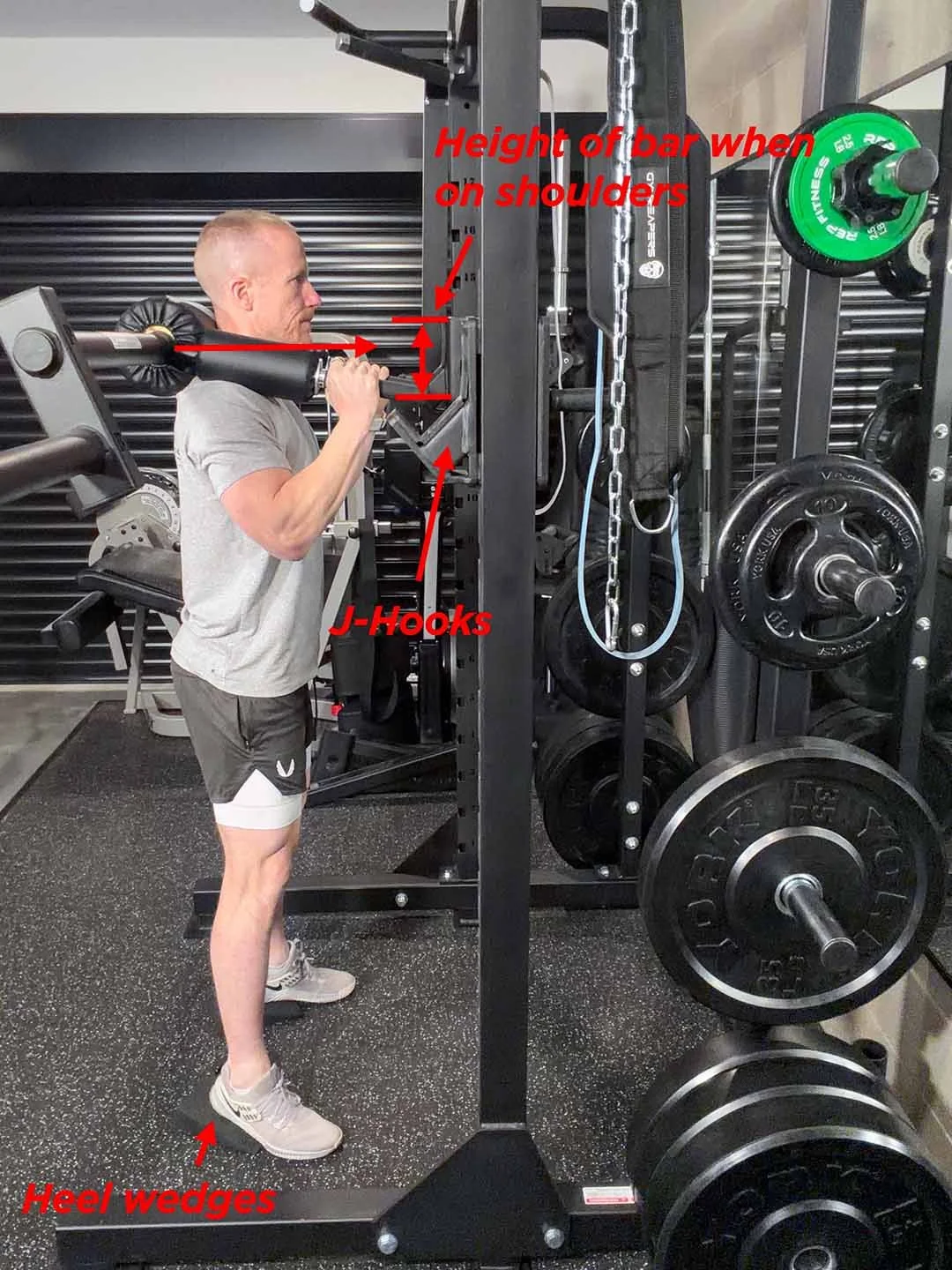
Figure 2: Ideal height of the J-Hooks for the Squat
Setting Up for the Exercise
J-Hooks: These are the hooks that hold the bar on the squat rack. Set the J-hooks slightly lower than shoulder height. When re-racking the weight you don’t want the hooks to be too low or too high. Ideally you want to be able to re-rack the bar just above the hook, onto the flat platform of the J-hook, without having to bend your knees or go on your toes (Figure 2).
Foot Stance: Make sure you know what foot stance feels best for you before performing the exercise. Choose a foot stance that suits your hip bone structure. If you have limited hip internal rotation, you will want to go with a wider and more turned-out foot position. This is also true if you have a relatively longer femur. You should know what foot stance is best for you before performing a barbell squat. If not, perform a series of bodyweight squats to figure out what feels best for you whilst also achieving good form (Figure 1). A good starting point is shoulder width apart with the feet turned out approx 30-45 degrees.
Heel Elevation: Determine if you need heel elevation. As a general rule, the knees and hips should travel a similar amount in opposite directions (think of a collapsing spring which stays symmetric). If you have tight ankles your knees won’t be able to travel forward that far. In an attempt to achieve more depth, your hips will continue moving backwards and you will have to bend forward at the spine to keep your centre of mass over your feet. This can put your lower back under unnecessary stress, which you will want to avoid. This can be mitigated by using wedges under your feet (Figure 2) to allow your knees to travel further forward. Note this will put your knees under greater stress, so if your quadriceps are relatively weaker this may need to be addressed before performing a heels elevated barbell squat. Try squatting with and without heel wedges, if you achieve more range of motion with heel wedges, you likely have a limitation in ankle mobility.
Safety Pins: Set the safety pins so that when you are at the bottom of your squat, with good form, the bar is an inch or so away from the pins (Figure 3).
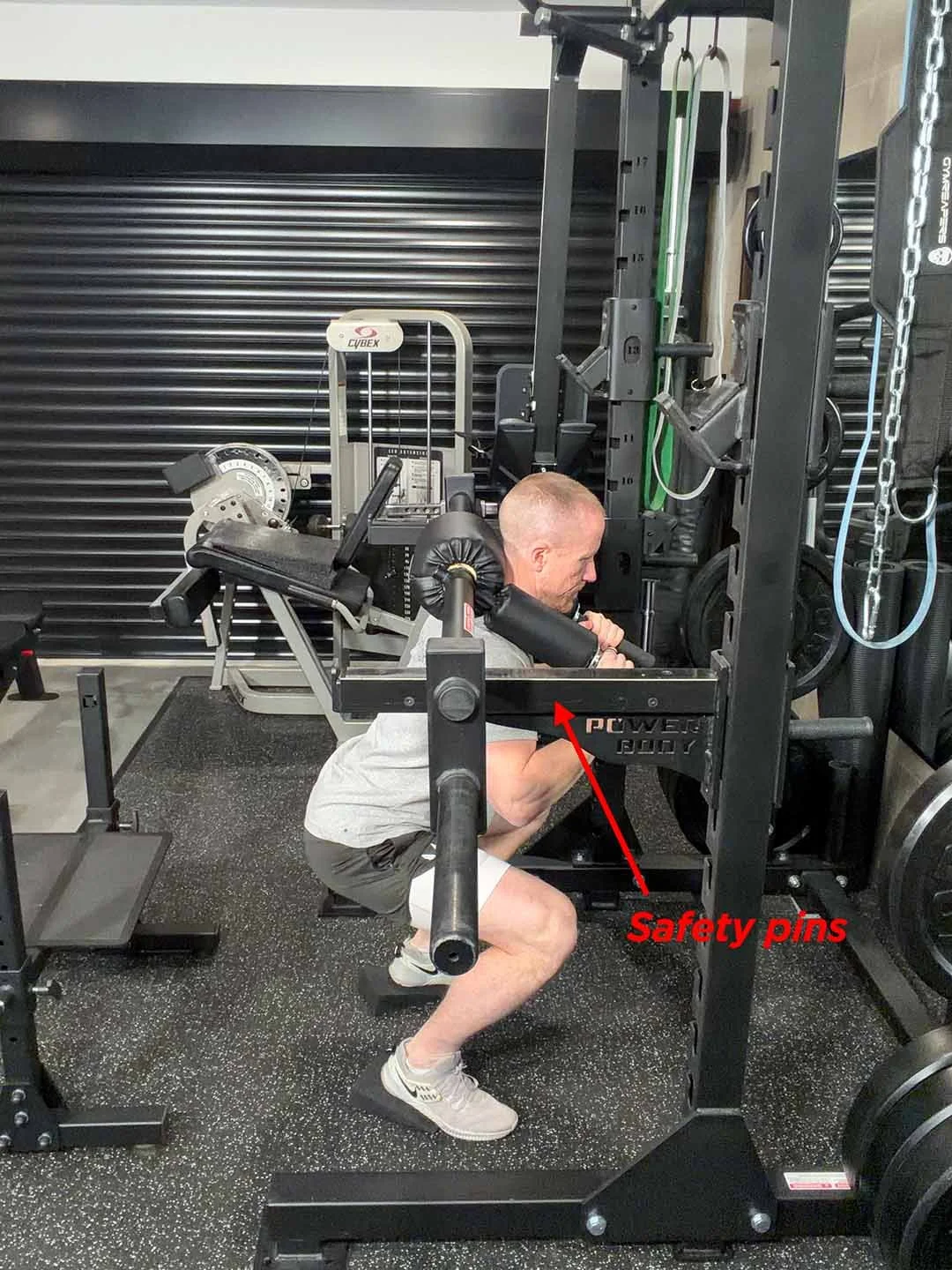
Figure 3: Barbell Back Squat with the safety pins in place.
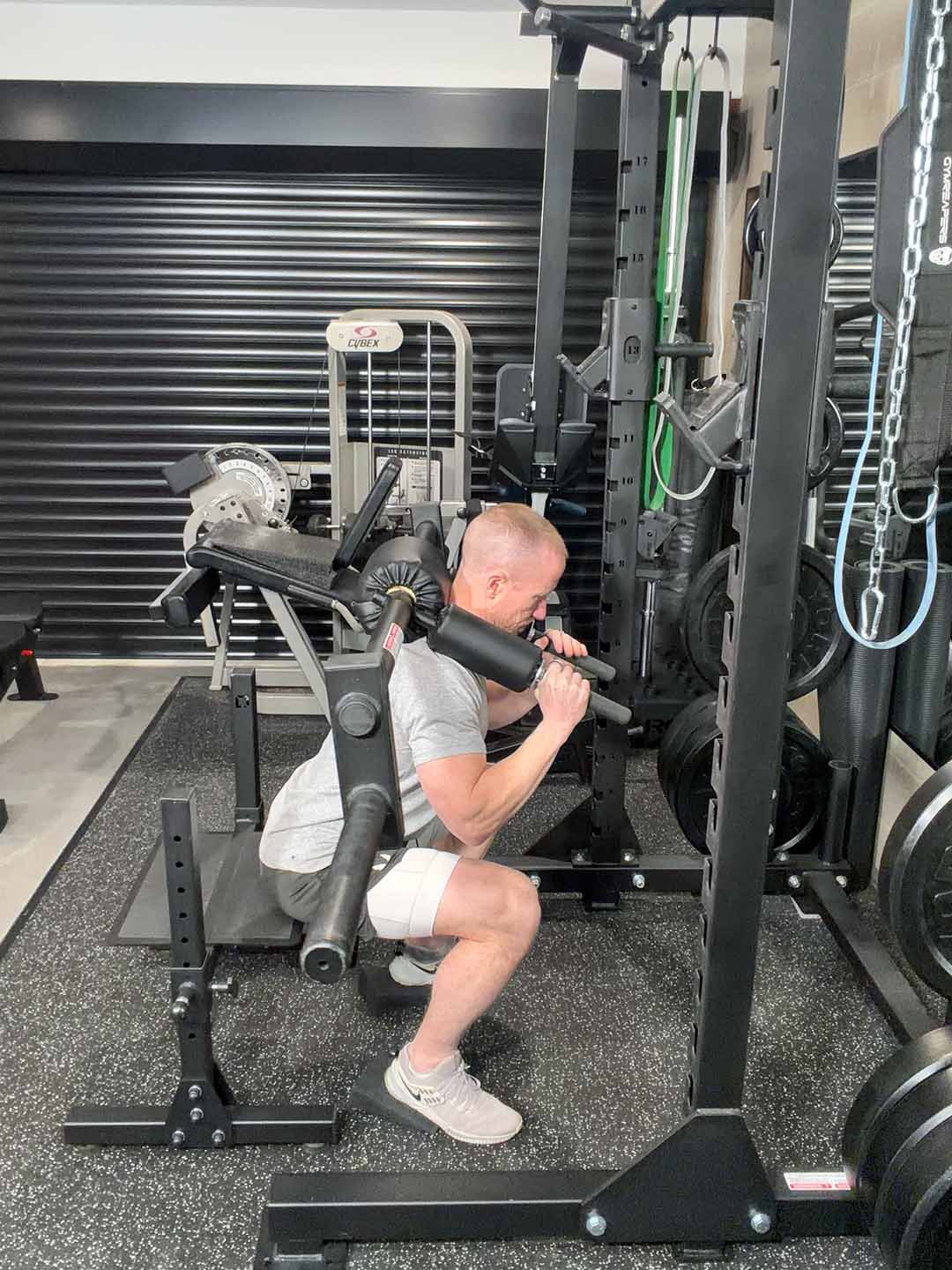
Figure 4: Barbell Back Squat to Box
Performing the Squat
Lifting the Bar: When un-racking the bar, bring one foot forward in front of the bar, so that you don’t have to bend forward to lift the weight off the rack.
The Movement: With your feet in the desired position, as determined above, initiate the movement by driving the knees forward, over the feet, and simultaneously pushing the hips backwards to lower your body. As you are doing so, maintain an upright chest/rib position to keep your spine neutral.
Squat Depth: Squat as low as you can whilst maintaining an upright and neutral spine. If you feel a rounding of the lowering back or pinching of the hips in the bottom position, you have gone too low.
Spine Orientation: The spine should not bend forward more than the shins. The Spinal Line and Tibia Line (Figure 1) should be parallel throughout the range of motion of the squat. If you have tight ankles, use wedges to elevate the heels and be mindful not to squat too low and lose form. Almost all lower back injuries in the squat occur because this criteria is not met or a neutral position is not maintained.
Front/Oblique view: The thigh, knee, shin and foot should be in alignment. You shouldn’t see any instability of the knees (e.g. knee moving inwards as you squat). If you do the weight could be too heavy or you may have a limitation in the feet or hips that needs to be addressed.
Head Position: It is best to keep the neck (cervical spine) neutral throughout the movement. Avoid looking to one side to see your form in the mirror or excessive extension of the cervical spine.
Have any questions?
Please comment below or contact us and we will be happy to help.
Want to Build Your Strength in the Barbell Squat?
If you’re reading this on or before January 5, 2026, we are running a BE Strong Challenge from January 5–10, 2026. Over this 8-week challenge, we’ll focus on increasing strength in the barbell back squat along with several other key lifts.